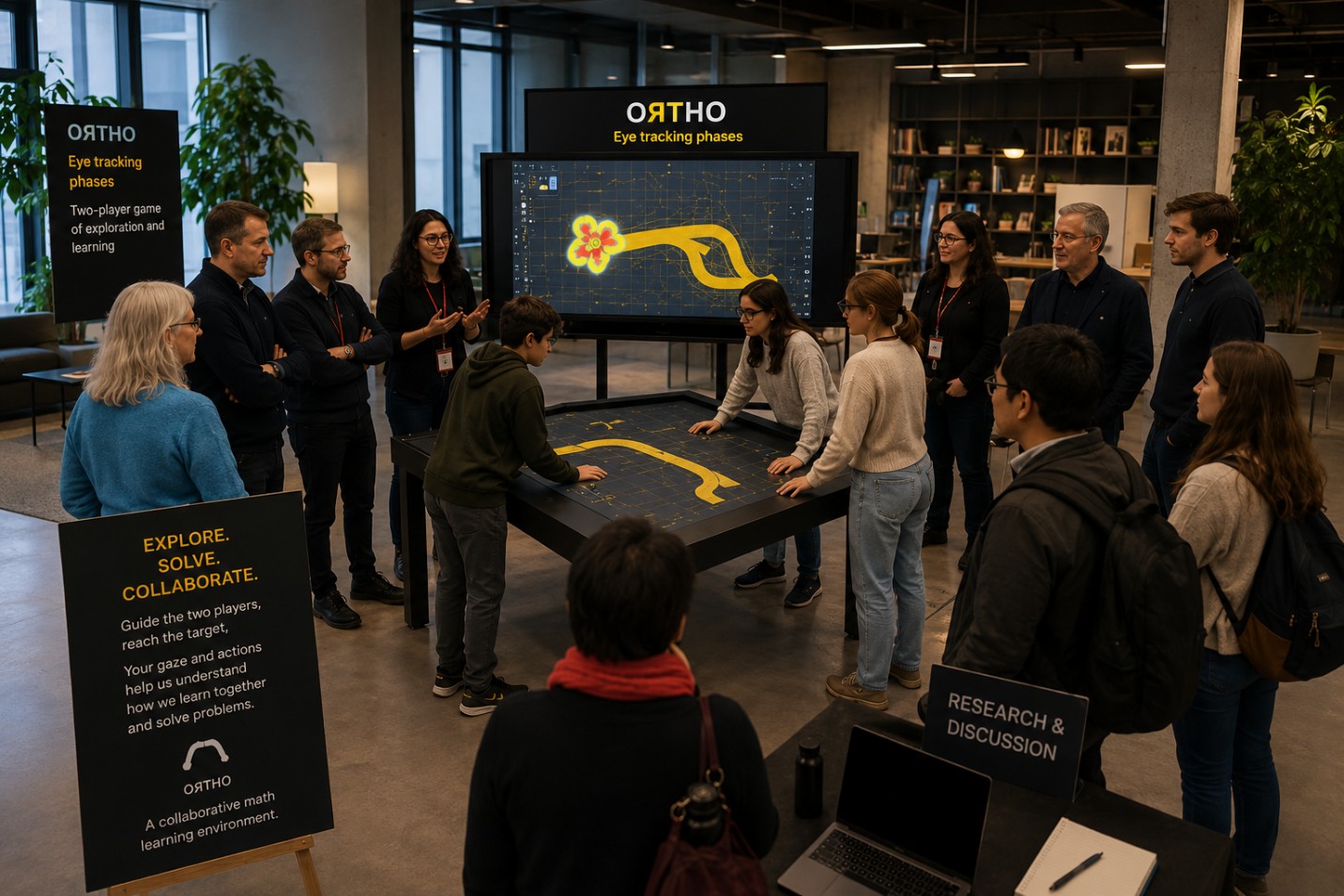




2pm. This seminar examines how interactive public spaces such as science centres can serve simultaneously as settings for science communication, education, and empirical research. Drawing on examples from the Copernicus Science Centre, it considers the various ways in which visitors can be involved in the creation of knowledge, ranging from participation in research to citizen science. It focuses on the LivingLAB, a participatory research project embedded within the Copernicus exhibition, with particular emphasis on its practical and procedural dimension: how studies are designed and conducted on the exhibition floor through a set of exhibit-like research stations. The OЯTHO exhibit serves as an illustrative case, through which the methodological and practical challenges of embedding research within public engagement settings are discussed, with attention to collaboration, learning, interaction, and ecological validity.
3pm. In the second part of the seminar, Professor Dor Abrahamson will present findings from the OЯTHO research game. OЯTHO is a digital-tabletop two-player game designed to investigate how people learn mathematical concepts through coordinating their joint action. Drawing on data collected in public science-center settings, he will discuss emerging findings on collaborative learning, embodied cognition, and mathematical thinking, as well as future directions involving artificial intelligence, virtual reality, and educational technology design.
The seminar also marks the launch of OЯTHO in Luxembourg, where the exhibit has been brought to the Luxembourg Science Center by Catalina Lomos and LISER with the support of the Luxembourg National Research Fund (FNR, INTER/MOBILITY/2024/SC/18945452 & PSP-CLASSIC/2025/19919740).